Define the task before reading the score
“Summarize documents” is too broad to make a useful model comparison. A sharper task might be: extract renewal dates from approved supplier agreements, point to the supporting passage, and return “not stated” when the date is absent. That description creates something you can check.
A model card helps place capability claims in context. Model Cards for Model Reporting proposes documentation of intended use, evaluation conditions, and performance characteristics. A card makes a claim more inspectable; it does not make it automatically applicable to your task.
Read the conditions around the result
| Look for | Ask next |
|---|---|
| Model identity | Which version, configuration, and deployment produced this result? |
| Intended use | Does your task resemble the evaluated use? |
| Evaluation setup | What inputs, prompts, tools, and scoring rules were used? |
| Known limitations | Which missing, ambiguous, or unusual inputs could matter to your users? |
| Cost & latency | Were retries, tools, and review included? |
Holistic Evaluation of Language Models argues for broader evaluation across scenarios and metrics. Its relevance here is methodological: a single result leaves other important properties unmeasured. A score for one task cannot answer every question about reliability or operational fit.
Scroll sideways to inspect the full diagram
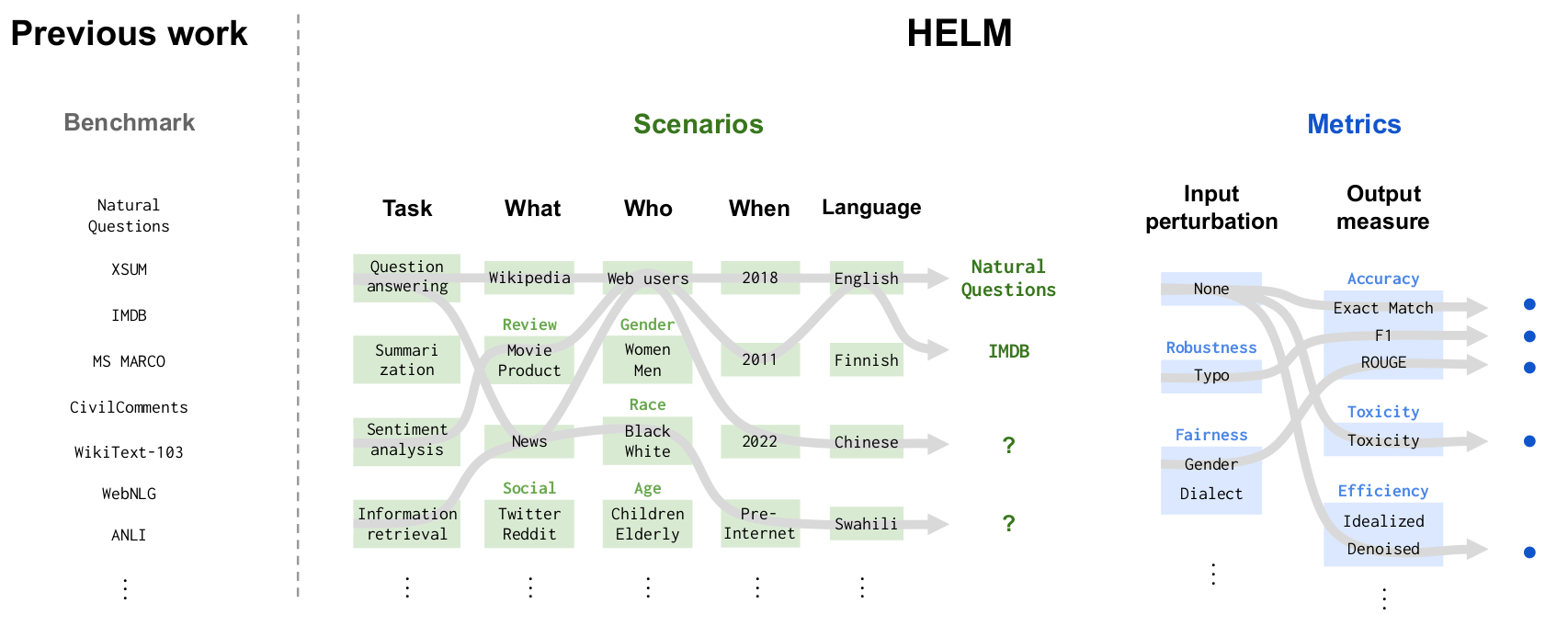
The original taxonomy makes the chosen tasks and missing coverage inspectable. This is a methodological diagram from 2022, not a current model comparison.
Source: Stanford CRFM · 17 November 2022 ↗Build a small, representative check
Collect authorized examples of the actual input. Include a typical document, a difficult layout, an ambiguous clause, and a case where the correct answer is missing. Write the acceptance rule before comparing outputs. For the renewal-date example, a date without a supporting passage should fail even if it sounds plausible.
Keep the input set and scoring rubric stable while changing one element at a time. Record the prompt, model identifier, settings, retrieval material, and tool access. Test again when one of those dependencies changes. Save failure cases because they explain more than a collection of polished demonstrations.
Separate a good format from a correct answer
A parser can tell you whether an output has the required fields. It cannot establish that the passage supports the date. Use mechanical checks for structure and knowledgeable review for meaning and consequential errors.
If another model helps judge answers, calibrate its judgments. The MT-Bench and Chatbot Arena research documents useful agreement in studied settings alongside limitations such as position and verbosity bias. A judge model is part of the evaluation system, not an independent source of truth.
This page supplies a method and an illustrative task. No model was benchmarked for this article, and no winner is implied. A useful result is a documented decision about your actual inputs and tolerance for failure.
Sources & reading trail
- Model Cards for Model Reporting — Mitchell and colleagues; 2018 preprint, revised January 2019.
- Holistic Evaluation of Language Models — Liang and colleagues; 2022 research on scenarios and multiple evaluation dimensions.
- Judging LLM-as-a-Judge with MT-Bench and Chatbot Arena — Zheng and colleagues; 2023 research on model-assisted judging and its limits.
The supplier-agreement task is a hypothetical teaching example. The checklist adapts the project’s evaluation research; it does not reproduce benchmark results.