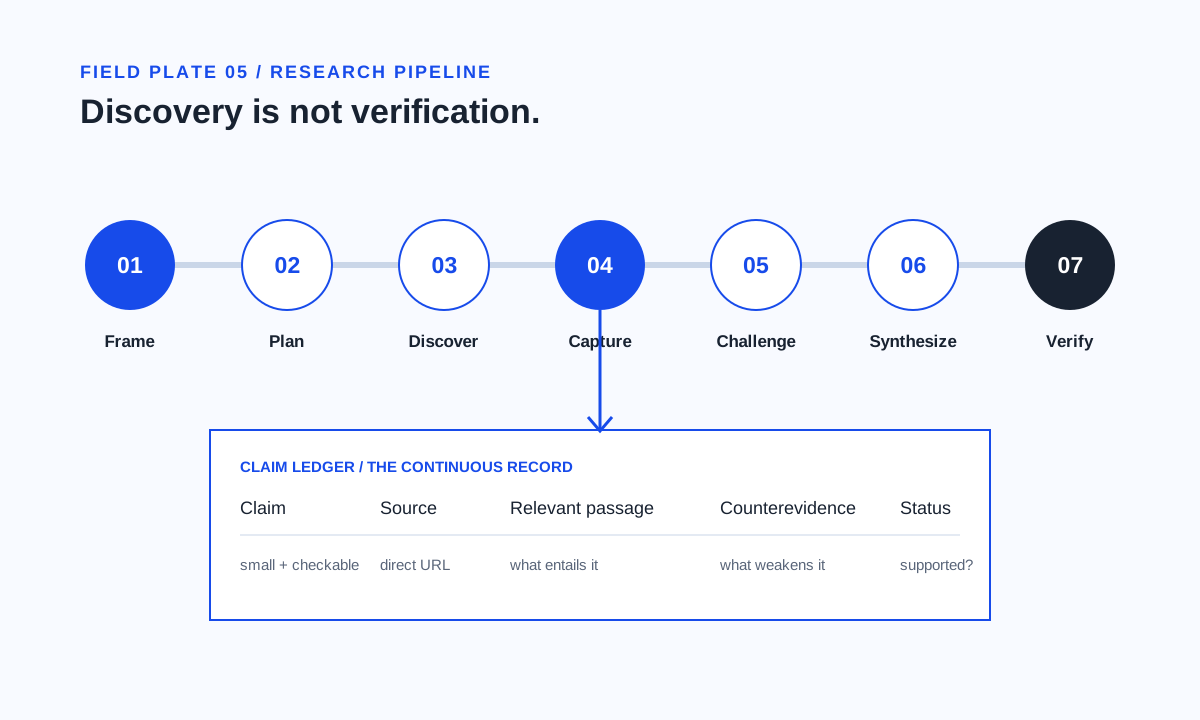
Seven stages, with a gate between each
- Frame the question. Name the audience, decision, geography, time boundary, and what would change the conclusion.
- Plan the evidence. List the primary documents, original research, official records, and independent measurements most likely to answer it.
- Discover candidates. Search broadly, but treat search snippets and summaries as leads—not evidence.
- Capture the record. Save title, publisher, author, publication date, URL, retrieval date, relevant passage, and evidence type.
- Build a claim ledger. Tie each material claim to support, counterevidence, uncertainty, and a status.
- Synthesize. Ask the model to draft only from the ledger and supplied documents. Keep facts, calculations, and editorial analysis distinct.
- Verify and publish. Open every cited source, check entailment, recalculate numbers, inspect dates, and route high-stakes conclusions to a qualified reviewer.
Search is for discovery. The source itself is for verification. A citation is not useful simply because it looks authoritative; the cited passage must actually support the sentence.
Use a claim ledger, not a pile of tabs
| Field | Purpose |
|---|---|
| Claim | The smallest factual statement that can be checked. |
| Evidence type | Primary official source, independent measurement, secondary analysis, user report, or editorial inference. |
| Source record | Direct URL, title, publisher, publication date, access date, and relevant passage. |
| Counterevidence | A conflicting result, caveat, or boundary condition. |
| Status | Supported, partially supported, contested, superseded, or unknown. |
| Freshness | Stable concept or time-sensitive claim; next review date. |
A ledger makes revision possible. If a provider changes a feature or a regulator updates guidance, you can find the affected claims without rewriting the entire article from memory. It also exposes gaps before polished prose hides them.
Separate extraction from interpretation
First ask for a structured extraction: what the source states, where it states it, the date, method, population, and caveats. Then compare the extraction with the source. Only after that should synthesis begin. This reduces the chance that a smooth summary quietly combines incompatible studies or upgrades a cautious finding into a universal claim.
For product comparisons, record the exact model, plan, endpoint, region, price-check date, settings, tools, and account conditions. If those details are unavailable, write “unknown” rather than filling the field with a plausible guess.
Search for disconfirmation
Once a draft conclusion appears, deliberately look for what would weaken it: a different population, a failed replication, a newer version, a policy exception, an implementation cost, or a source with a conflicting incentive. Ask the model to identify unsupported leaps, but verify its critique just as carefully as the draft.
The publication check
- Does every material factual claim have direct support?
- Does each source entail the wording, or merely discuss the same topic?
- Are vendor claims identified as vendor claims?
- Are dates attached to time-sensitive facts?
- Are estimates accompanied by assumptions and formulas?
- Are contradictory sources represented fairly?
- Are quotations exact and within an appropriate excerpt?
- Does the page say what was not tested or could not be established?
- Can a reader report a correction?
A research brief is not ready because it has ten citations. It is ready when each decision-relevant claim has suitable support, the links resolve to the inspected material, uncertainty is visible, and another reviewer can reproduce the reasoning trail.
This page represents the report’s source-grounded research workflow, evidence hierarchy, claim labels, dated comparison record, and review checklist. The report’s internal editorial cadence and private site roadmap are not published here.
Evidence policy
Model Field Guide prioritizes primary official sources and original research for factual claims, uses independent measurement for validation, and treats secondary analysis or community reports as context and leads. See About & method for the public evidence categories.