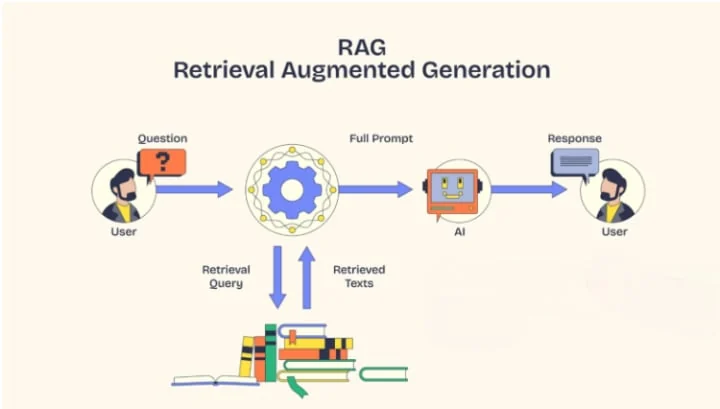
A generator with a document index attached
Researchers from Facebook AI Research posted Retrieval-Augmented Generation for Knowledge-Intensive NLP Tasks on 22 May 2020. RAG combines what the paper calls parametric memory, a pretrained sequence-to-sequence model, with non-parametric memory, a dense vector index built over Wikipedia, so that generation is conditioned on documents the retriever pulls back for a given input rather than relying only on facts encoded in the model's weights during training.
What the paper measured, and how it trained the pieces
The paper reports that RAG set the state of the art on three open-domain question-answering tasks at the time, and that its generated text was more specific, diverse and factual than a comparable parametric-only sequence-to-sequence baseline on the tasks tested. The retriever and generator in this original formulation are fine-tuned together on the downstream task, so the retrieval step is shaped by the same training signal as the generation step, rather than being built and frozen as a separate off-the-shelf component. A Meta AI post from 28 September 2020, announcing the architecture's release inside the Hugging Face transformers library, frames the practical benefit differently: because retrieved documents can be swapped out, updating what the system knows does not require retraining the whole model, only replacing the document index.
How later practice diverged from the paper
The phrase 'retrieval-augmented generation' is now commonly used for systems that look nothing like the paper's joint-training setup: an off-the-shelf embedding model builds a vector index, a separately trained or purely prompted generator reads back whatever the index returns, and the two components are never trained together. The 2020 paper's reported gains are specific to its jointly trained configuration and its choice of Wikipedia as the retrieval corpus; they do not establish that a frozen retriever paired with an unrelated generator will behave the same way, or that factuality gains transfer automatically to a different document collection. The Meta post's claim about avoiding retraining applies to updating the document index, not to changing the underlying generator's behaviour, a distinction that gets lost when 'RAG' is used as a generic label for any retrieve-then-generate pipeline.
Questions to carry into your own evaluation
- Is a system described as RAG actually training retriever and generator jointly, or bolting a frozen retriever onto an unrelated model?
- Does a factuality or specificity claim come from the same document corpus the 2020 paper used, or from a different collection with different coverage?
- Does updating the document index actually change the generator's behaviour in the way a knowledge-update claim assumes?
The original RAG paper is a specific, jointly trained architecture tested against Wikipedia-grounded question answering. Much of what is now called retrieval-augmented generation is a looser descendant of that design, and a claim inherited from the 2020 paper should be checked against how closely a given system actually matches it.
Sources & reading trail
States the joint retriever-generator architecture, its Wikipedia index, and its state-of-the-art open-domain QA results.
Source published: 22 May 2020 · Retrieved: 16 September 2026
Announces the Hugging Face release and frames the document-swapping benefit for updating knowledge without retraining.
Source published: 28 September 2020 · Retrieved: 16 September 2026
Papers and official documents establish the record; the reading and the questions are Model Field Guide editorial analysis. This retrospective draft does not imply the site published on the event date.