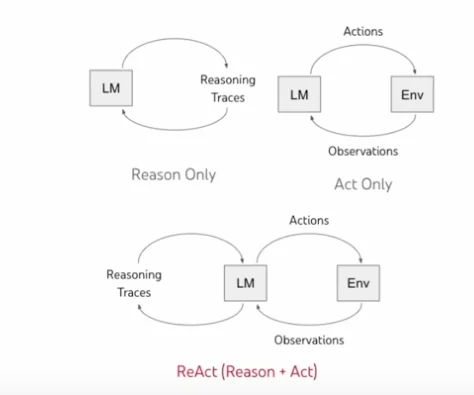
Reasoning traces and actions in one interleaved stream
Earlier prompting methods either asked a model to reason in text without touching any outside tool, or to act without narrating why. The ReAct paper, submitted in October 2022, prompts a model to generate reasoning steps and task-specific actions in an interleaved sequence, so a reasoning step can plan the next action and an action's returned result can feed back into the next reasoning step, rather than treating thought and action as separate passes.
What was tested and what the paper reported
The paper tests the method on question answering over HotpotQA, fact verification on FEVER, and two interactive decision-making environments, ALFWorld and WebShop, giving the model access to a Wikipedia search API for the first two. On HotpotQA and FEVER, the paper reports that interleaving reasoning with the Wikipedia interface reduced hallucinated facts and error propagation compared to reasoning-only baselines, and produced trajectories the authors describe as more interpretable. On ALFWorld and WebShop, it reports absolute success-rate improvements of 34 and 10 percentage points respectively over the prior methods it compared against, using only a small number of in-context examples rather than task-specific fine-tuning. The paper also reports that smaller models fine-tuned on ReAct-style trajectories outperformed larger prompted models on the tasks tested, though that specific comparison used its own fine-tuning setup.
Why the pattern became a template, and its limits
The project's own page includes a documented ALFWorld failure case, used by the authors to illustrate that inspecting a trajectory can reveal where a plan went wrong, which is itself evidence that the method's transparency does not guarantee correctness, only inspectability. The improvements reported are specific to the four benchmarks and the particular tool, Wikipedia search, that the paper wired up; a different tool, a noisier retrieval interface, or a task where the correct action is not clearly bounded by a small action space was not part of this evaluation. The later Toolformer paper addresses a related but distinct problem, training a model to decide for itself when to call an API rather than being prompted with a fixed interleaving pattern, indicating the two lines of work solve adjacent parts of tool use rather than the same one.
- Does the target task have a bounded, well-defined action space similar to the paper's four benchmarks?
- Is the tool interface as reliable as the Wikipedia search API the paper used, or noisier?
- Are the reported success-rate gains measured against a comparably tuned baseline, or a weaker one?
The paper's contribution is a tested prompting pattern with reported gains on four specific benchmarks; its wide adoption as an agent template is a separate, later development the paper itself does not claim to predict or measure.
Sources & reading trail
States the interleaved reasoning-and-acting method and reports HotpotQA/FEVER hallucination reduction and 34/10 point success-rate gains on ALFWorld/WebShop.
Source published: 6 October 2022 · Retrieved: 16 September 2026
Project page naming authors and affiliations and presenting a documented ALFWorld failure case used to illustrate the method's inspectability.
Source published: Not established · Retrieved: 16 September 2026
Later paper addressing the adjacent problem of a model deciding for itself when to call a tool, distinguished here from ReAct's fixed interleaving pattern.
Source published: 9 February 2023 · Retrieved: 16 September 2026
Papers and official documents establish the record; the reading and the questions are Model Field Guide editorial analysis. This retrospective draft does not imply the site published on the event date.